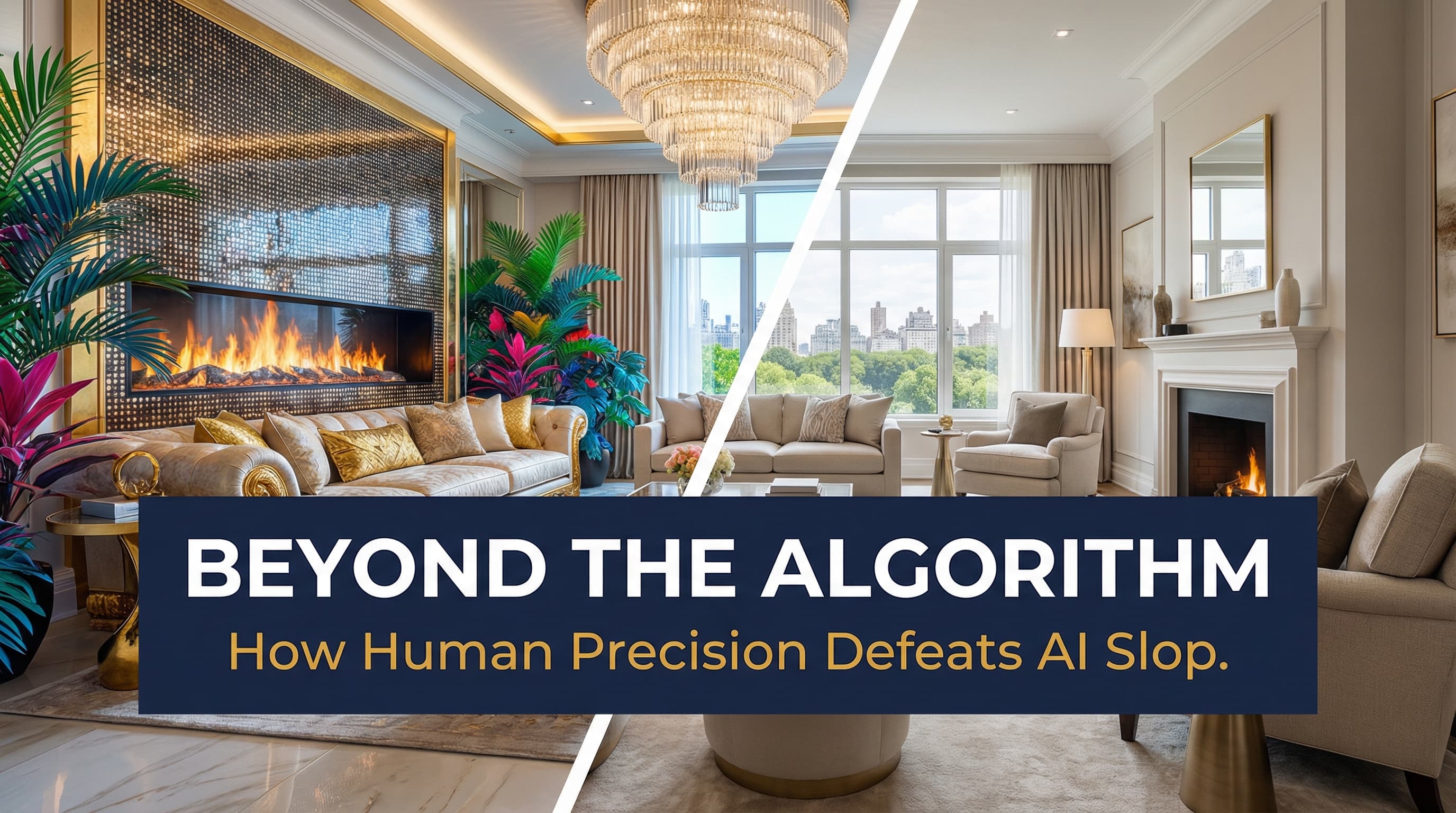
Beyond the Algorithm: How Quickhome Prevents "AI Slop" with Human Precision
Key Takeaways
- Generic AI tools produce “AI slop”—unstructured outputs that hallucinate features and misrepresent properties
- FTC Section 5 and state laws like California AB-723 create material legal exposure for AI-generated misrepresentations
- Quickhome's multi-layer model combines AI guardrails, computer vision QA, and human review to prevent misrepresentation
- Every image is reviewed by a trained QA specialist, creating an auditable chain of custody
For REIT executives and institutional property managers, the rapid adoption of generative AI in marketing is a double-edged sword. While efficiency gains are undeniable, the rise of “AI slop”—unstructured, hallucinated outputs from generic AI tools—presents a direct threat to fiduciary duty and brand integrity.
As regulatory scrutiny intensifies at both the federal and state level, property photos can no longer be treated as mere creative assets. In regulated housing markets, they function as regulated representations of an underlying physical asset. Navigating this environment requires more than a powerful model. It requires a sophisticated Human-in-the-Loop system designed to mitigate vicarious liability, enforce disclosure discipline, and withstand regulatory and legal review.
1. Defining the “AI Slop” Crisis in Institutional Real Estate
In the context of institutional real estate, “AI slop” refers to the output of generic, unstructured generative AI tools that lack real estate–specific guardrails. These systems often hallucinate features to optimize for aesthetic appeal, inadvertently producing images that misrepresent the true condition, layout, or features of a property.
For institutional owners, the risk is not limited to poor visual quality. It includes digital fabrications that can materially mislead consumers and regulators alike, such as removing permanent defects, inventing architectural features, or altering functional layouts.
Key Risk: How Unstructured AI Creates Deceptive Listings
Structural Hallucinations
Digitally adding windows, balconies, or altering load-bearing walls—creating representations of living spaces that are physically impossible.
Concealment of Material Defects
Automatically “cleaning” images by removing permanent flaws such as water damage, structural rot, or visible utility infrastructure—potentially violating mandatory disclosure statutes.
Fabricated Amenities
Introducing synthetic fixtures, appliances, or finishes that do not exist in the unit, creating bait-and-switch exposure once a prospect visits the property.
These are not cosmetic errors. They are misrepresentations of the asset itself.
2. The High Stakes of Hallucinations: Legal and Fiduciary Risk
The regulatory landscape has shifted materially. Federal oversight under the Federal Trade Commission Act Section 5 applies a “significant minority” standard. A practice may be deemed deceptive even if it misleads only a meaningful subset of consumers, not necessarily a majority. For a REIT or institutional operator, an AI tool that removes a defect or fabricates a benefit is not a marketing mistake. It is a material misrepresentation of the property's condition or value.
At the state level, the so-called “California Effect” is now firmly in play. With California AB-723, effective October 2025, and New York's Article 14, the Property Condition Disclosure Act, among the highest transparency standards in the United States, institutional operators increasingly must design workflows that meet the strictest requirements nationwide. In New York, Section 442-c introduces vicarious liability exposure when brokers or operators fail to supervise the tools and processes used by field teams.
To maintain a defensible posture, operators must clearly distinguish between permissible normalization and impermissible misrepresentation.
The distinction regulators and courts care about is not whether AI was used, but whether the output materially alters a consumer's understanding of the asset.
| Aesthetic Normalization (Lower Risk) | Material Misrepresentation (High Risk) |
|---|---|
| Lighting and Exposure Correction: Adjusting white balance and exposure for clarity. | Structural Fabrication: Adding windows, balconies, or altering floor plans. |
| Sky and Grass Enhancement: Replacing overcast skies or dormant grass with representative natural conditions. | Defect Concealment: Removing evidence of water damage, rot, or utility infrastructure. |
| Perspective Correction: Straightening angles within the bounds of the original photo. | Feature Modification: Changing permanent cabinetry, flooring, or fixtures without clear renovation labeling. |
3. The Quickhome Multi-Layer Protection Model
Quickhome treats property imagery as regulated representations, not decorative content. Our platform adheres to National Association of Realtors Policy Statements 7.86 and 7.93 and is engineered to support the MLS “True Picture” standard. This approach is operationalized through a dual-layer protection model.
Controlled AI Image Enhancement Framework
1. Proprietary AI Guardrails
Quickhome's AI operates within hard-coded constraints that explicitly restrict structural or material misrepresentation. The system cannot hallucinate new windows, remove permanent utility lines, or fabricate architectural elements. These guardrails are enforced at the model orchestration level to prevent prohibited alterations before an image reaches human review.
2. Validated Prompt Architecture
Base prompts are continuously tested and scored for consistency and policy adherence. For dynamic prompt generation, the system intelligently combines customer inputs (e.g., “replace appliances with stainless steel”), reference imagery, and extracted image attributes (room type, lighting, etc.) to create a context-aware prompt tailored to each property photo.
3. Computer Vision Quality Control
All generated images undergo automatic evaluation via computer vision QA systems. This layer checks for structural consistency, visual artifacts, prompt adherence, and policy violations. Images that fail automated validation are rejected prior to human review.
Human Quality Assurance
Quickhome rejects black-box automation. Every image undergoes final review by a trained QA specialist. Each output is graded, logged, and tracked to improve system performance over time. This creates an auditable chain of custody that preserves the original state of the asset and supports defensibility in the event of regulatory inquiry or subpoena, including under New York Section 442-e.
4. The Human Element: Why We Review Every Image
The core differentiator in Quickhome's integrity model is the human reviewer. While generic AI systems optimize for engagement metrics such as clicks or visual novelty, our QA process optimizes for truthfulness, consistency, and auditability. Human intervention is what transforms AI output into an enterprise-grade marketing asset.
The Human QA Checklist
Capital Improvement Verification
Validating that renovation previews align with documented capital plans, ensuring that digital cabinetry, flooring, or finishes match approved rehab specifications.
MLS “True Picture” Compliance
Confirming that perspective correction and reframing remain representative of actual physical dimensions.
Cross-Angle Consistency
Ensuring that enhancements such as virtual staging or renovation previews are consistent across all images of the same unit, preventing disappearing or contradictory features.
Mandatory Disclosure Audit
Verifying that required labels are present and meet the federal “Clear and Conspicuous” standard.
5. Operationalizing Transparency Through Mandatory Labeling
Human oversight ensures that transparency is not optional or discretionary. It is embedded into the asset's digital record. Quickhome provides optionality for standardized labels that persist with the image, even as it is syndicated to third-party portals and listing platforms.
“Renovation Preview – Final look may vary”
Required for any image depicting planned upgrades. This protects fiduciary duty by clearly indicating a future-state visualization.
“Virtually Staged”
Required whenever synthetic decor is added to provide scale or context, consistent with NAR Policy 7.35.
“Enhanced representative image”
Required for exterior visuals in zero-photo or limited-data scenarios, clearly distinguishing illustrative imagery from current-condition photography.
These labels are designed to survive downstream syndication, ensuring that compliance does not break when images leave your direct control.
6. Trust as a Competitive Advantage
In a digital-first leasing environment, compliance is not an administrative burden. It is a driver of ROI. By designing for the highest regulatory standards, Quickhome enables REITs and institutional operators to deploy a single, defensible workflow across all 50 states.
This approach protects brokerage licenses, satisfies duty-of-supervision obligations under New York §175.21, and provides legal teams with a defensible audit trail. High-integrity imagery builds consumer trust, reduces friction during tours, and shortens vacancy periods—ensuring that pre-marketing visuals are as legally resilient as they are visually compelling.
Founder's Note
Quickhome was engineered to bridge advanced AI technology with institutional risk management. Co-founder Corey Feduck previously led a 45-person machine learning operations team automating computer vision for satellite imagery, bringing ground-truth discipline to large-scale visual systems. Co-founder Patrick Engdahl helped manage a $1B lending platform at PeerStreet, ran product for Zillow Offers Renovation team, and scaled Zillow's listing media division, developing a deep understanding of the financial, operational, and regulatory consequences of inaccurate representations.
Quickhome was built with a single principle in mind: integrity should never be sacrificed for speed.
Related Articles
AI Photo Enhancement in Real Estate: Why Compliance Is Now the Foundation
Learn how AI is transforming real estate listings and why compliance with federal, state, and MLS standards is essential.
FTC Consumer Protection Laws and AI Photography
How federal truth-in-advertising principles apply to AI-enhanced real estate imagery.
MLS Rules and NAR Standards
How MLS and NAR standards govern AI-enhanced listing imagery.
Protect Your Institutional Reputation
Streamline your marketing with the industry's most reliable AI-powered visualization platform. Book a demo or start your free trial today.
Get Started Free