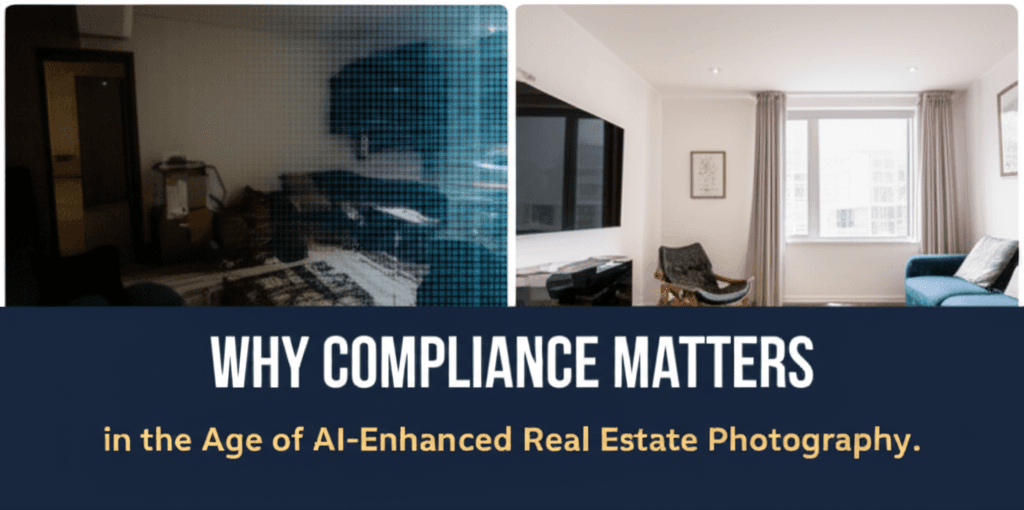
AI Photo Enhancement in Real Estate: Why Compliance Is Now the Foundation
Key Takeaways
- AI-enhanced visuals are becoming standard in real estate marketing
- Federal, state, and MLS standards all apply to AI-enhanced listing imagery
- Compliance by design is essential for responsible AI adoption at scale
- AI does not change the rules—it raises the stakes
Artificial intelligence is rapidly transforming how real estate listings are created, enhanced, and brought to market. What once required professional photographers, staging teams, and long turnaround times can now be accomplished in hours through AI-powered photo enhancement, virtual staging, and renovation previews.
This shift is not theoretical. AI-enhanced visuals are already becoming a standard expectation in online listings, driven by consumer demand for high-quality imagery and by operators' need for speed and scale. But as AI becomes embedded in listing workflows, it introduces a parallel transformation—one that is less visible but far more consequential: listing photos are increasingly treated as regulated representations rather than creative marketing assets.
Across federal consumer protection law, state regulations, and MLS and NAR standards, the message is consistent. AI does not change the rules. It raises the stakes.
Why AI Photo Enhancement Is Becoming the Default
Real estate discovery is now overwhelmingly digital. Listings live or die on the quality of their visuals, and better images consistently drive higher engagement, more tours, and faster decisions. AI accelerates this process by enabling:
- Faster turnaround from move-out to market
- Consistent visual quality across large portfolios
- Virtual staging that helps consumers imagine space
- Pre-marketing during renovations or construction
AI tools are no longer experimental. They are becoming part of everyday listing workflows, particularly for institutional owners and property managers operating at scale.
However, the same realism that makes AI powerful also makes it risky. When an image looks real, consumers reasonably assume it reflects reality. That assumption is where compliance begins.
Federal Consumer Protection Sets the Baseline
At the federal level, long-standing truth-in-advertising principles apply fully to AI-enhanced listing imagery. Under Section 5 of the FTC Act, marketing materials may not be unfair or deceptive, regardless of whether the misrepresentation is intentional.
Images matter because they are material. Visual representations of a property's condition, features, or planned upgrades influence whether a consumer tours, applies, or signs a lease. When AI is used to add finishes, remove defects, or depict future states, those visuals can become express claims about the property.
From a regulatory perspective, the question is not whether AI was used, but whether the image could reasonably mislead a consumer. Clear disclosures, factual grounding, and consistency between visuals and reality are the difference between compliant innovation and regulatory exposure.
Learn more about FTC consumer protection laws and AI enhancements →
State Laws Raise the Bar, Especially in California
While federal law provides the floor, state consumer protection laws often raise the ceiling. States like California have emerged as de facto standard setters for digital transparency, particularly as AI-generated and enhanced media become more prevalent.
California's approach emphasizes clarity, disclosure, and the prevention of consumer confusion. In practice, this means that when images are digitally altered in ways that change how a property is perceived, those alterations must be clearly disclosed in context—not hidden in fine print or detached explanations.
For multi-state operators, the implication is clear. Designing for the most stringent jurisdictions reduces long-term risk and simplifies operations. Compliance by design is no longer optional.
Read about state consumer protection laws and California's AI standards →
MLS Rules and NAR Standards Treat Photos as Data
Within the MLS ecosystem, listing photos are not treated as marketing flair. Under NAR policy, photos, virtual tours, graphics, and renderings are all considered Listing Content. As such, they are subject to accuracy, integrity, and enforcement standards in the same way as square footage or property status.
MLS rules generally require that photos accurately depict the property and do not mislead participants or the public. When AI is used to materially alter an image—such as through virtual staging or renovation previews—the image can remain compliant only if those changes are clearly disclosed.
Equally important is auditability. MLS governance and enforcement depend on the ability to review source data, assess changes, and resolve disputes. Platforms that preserve original images alongside enhanced versions support this process. Platforms that do not introduce systemic risk.
Explore MLS rules and NAR standards in an AI-driven market →
How Quickhome Supports Compliance by Design
Quickhome was designed as a real estate–specific AI platform, not a general-purpose image generator. That distinction matters.
Rather than treating compliance as a policy document, Quickhome embeds it directly into the product workflow through several core principles:
Clear Categories of Enhancement
Quickhome differentiates between non-disclosable enhancements, such as lighting and color correction, and digitally altered imagery, such as virtual staging and renovation previews. This aligns with how regulators, MLSs, and NAR standards evaluate material changes.
Per-Enhancement Disclosures
Customers can apply disclosures based on the specific enhancement used. A virtually staged image can be labeled accordingly, while a renovation preview can include clear language indicating future intent and variability.
Source Image Linking
Quickhome preserves and links the original source image alongside the enhanced version. This supports MLS auditability, internal reviews, and consumer trust by making transformations transparent.
Human QA Oversight
AI outputs are reviewed by trained human QA teams to ensure enhancements remain within permitted boundaries and do not introduce misleading elements.
Together, these features allow customers to move quickly without sacrificing defensibility. Compliance becomes part of the workflow, not a bottleneck.
Compliance as a Competitive Advantage
The real estate industry is not moving backward from AI adoption. The question is not whether AI-enhanced imagery will be used, but whether it will be used responsibly.
Operators who embed compliance into their visual workflows can pre-market earlier, reduce vacancy periods, and scale listings confidently across jurisdictions. Those who ignore disclosure, auditability, and accuracy risk regulatory scrutiny, consumer distrust, and operational disruption.
AI's real value is unlocked when innovation and integrity move together. By aligning federal consumer protection principles, state disclosure expectations, and MLS and NAR standards into a single, coherent workflow, Quickhome helps teams adopt AI with confidence, clarity, and compliance at the core.
Related Articles in This Series
FTC Consumer Protection Laws and AI Photography
How federal truth-in-advertising principles apply to AI-enhanced real estate imagery.
State Laws and California AI Standards
Why California is shaping AI standards in real estate marketing nationwide.
MLS Rules and NAR Standards
How MLS and NAR standards govern AI-enhanced listing imagery.
Ready to Adopt AI with Compliance Built In?
Quickhome AI helps property managers and real estate professionals enhance listings at scale while maintaining full compliance with federal, state, and MLS standards.
Get Started Free